 by Beth Offenbacker
The first time I walked into the Shenendehowa Free Library in 1977 as a shy, nerdy 12-year old, my world was transformed. I immediately felt at home. The creaky floor of the former schoolhouse and the enchanting scent of “eau de book” made me feel welcome that first day and every time thereafter.
Little kids, gangly teens like me, parents, older adults, all were milling about the two rooms, discovering the magic this new place had to offer in the form of all kinds of books. The realization was immediate for me: Here were other people who loved books as much as I did!
There is nothing quite like finding connection with other people with whom you share a great affinity for something. I am still in love with books and learning after many well-spent hours visiting the Shenendehowa Free Library, now known as the Clifton Park-Halfmoon Public Library. And when I travel, I sometimes go to the library in that particular city or town too.
But what’s the backstory behind the library movement? How did these community gathering places for book lovers happen to become commonplace across so many communities? I was curious to learn more.
Third Places
To no surprise, I learned that it was our inventive founding father Benjamin Franklin who started the first library, recognizing the value that sharing books could bring…and unintentionally (or perhaps intentionally) building ties that could sustain a fledgling nation.
It makes sense when we realize how scarce books were in the British Colonies. Of course, there weren’t any of the modern technologies at that time, like televisions and social media, to keep people entertained or support learning. Books were the technology of the day.
Libraries met the immediate needs of at growing populace and have since blossomed as “third places,” as sociologist Ray Oldenburg describes physical locations outside of home and work that provide greater benefits to people and communities than just the place itself. Our library became my third place as a teenager, and it remains one of my favorite places for that reason, even today.
Fostering a New Nation
Notably, what Franklin did was to take a very old idea — think of the Great Library in Alexandria, Egypt, which built on libraries established in ancient Greece and the ancient Near East — and change it up in a way that enabled men to grow as citizens in this very new country.
According to the Digital Public Library of America, the first American libraries were subscription-based, essentially private clubs that men belonged to for a small fee. Today, there still are a small number of subscription libraries in existence, usually for specialized subject areas. The first subscription library in America was the Library Company, founded by Franklin, in Philadelphia in the 1730s.
The Public Library is Born
Franklin then later played a role in establishing the first lending library in 1790, when he donated a collection of books to a town in Massachusetts that then named itself Franklin, MA. in homage to him. The town voted to make the books Franklin donated available for loan to town members, thereby establishing the first public library.
The prevalence of public libraries like the one in Franklin, MA, grew after the Civil War, and over time, libraries became tax-supported. These institutions anchored their missions to serving the public’s needs, which we see mirrored today in the services and programs of our own beloved Clifton Park-Halfmoon Public Library.
The rapid growth of libraries in the late 1800’s through the 1920’s also was a result of significant philanthropic support from industrialist Andrew Carnegie. In all, Carnegie funded a staggering 2,509 libraries in the U.S. and abroad, with 1,687 of them in America, earning him the sobriquet “Patron Saint of Libraries.”
Interestingly, 107 of those Carnegie-funded libraries are in New York State. Ones closest to us in Saratoga County include libraries in Schenectady, Amsterdam, Chatham, and Gloversville.
Reflecting the Times
Libraries as public-serving institutions reflected social mores of the times. Men from elite New England families were key players in the early years of the library movement, with elite women also volunteering, often to work with children. Perhaps in alignment with the shifting roles of women across society, more women took on leadership roles in libraries starting in the early 1900’s.
Libraries also were maturing as institutions, becoming professionalized through specialized training. Columbia University established the very first School of Library Science in 1887, which was founded by Melvil Dewey (who created the well-known Dewey Decimal System, still in use today).
Two years later, the program decamped to Albany, where Dewey spent the next 37 years leading the New York State Library School. It’s exciting to know that our region played a noteworthy role in the advancement of the library profession!
Mobile Libraries
Libraries outside of libraries…bookmobiles, as they are known, became common with the advent of cars and trucks. If people could not physically get to the library, the library came to them.
This was also the case in times of war. In 1917, the Library War Service was established by the American Library Association. Its mission was to provide books to American soldiers training in camps and serving overseas in the war. From 1917-1920, the LWS built 36 camp libraries and provided seven to ten million magazines and books to soldiers. This included books in braille to soldiers who were blinded in battle.
Vehicles were not the only way people had library access. The Giver of Stars by Jojo Moyes, in fact, tells the story of a group of women in 1930’s Kentucky who delivered books to individuals and families living in remote areas, with the librarians traveling by horseback, often an hour or two each way, to deliver or retrieve books.
Community Programs
As those “third places,” libraries from the start served as places where both current and new community members could connect and learn together. Access to books and other educational materials, hosting of arts and music programs, and convening meetings and events (such as the recent Clifton Park-Halfmoon Public Library’s Genealogy Day) for the social exchange of knowledge, all are part of the library movement’s “secret sauce.”
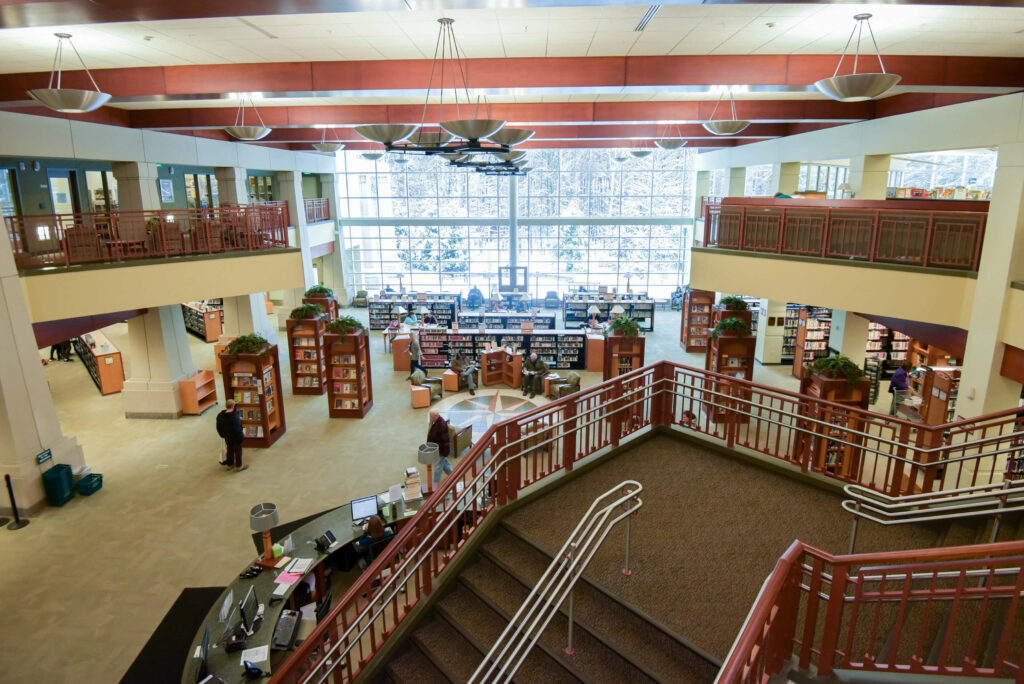
As community needs shift, so too does the nature of what’s offered by libraries. Today, our own library offers several types of programs that support community needs, from arts & crafts groups and book clubs, to citizenship and computer/technology classes, and more. The recent addition of a Sensory Room is a good example of how the library has adapted to our community’s shifting priorities and interests.
Keeping “the Movement” Moving
The Friends of the Clifton Park-Halfmoon Public Library (“CPH Friends”) is a part of ensuring that the library itself continues to flex and grow in step with community needs. This august body works closely with the library’s director and staff to support the organization’s strategic goals and fill gaps when possible.
The idea of Friends groups to support libraries in this way started in the 1950’s, according to American Libraries Magazine. More than 5,000 Friends groups exist across America, hosting a range of events and activities that further the goals of the libraries in their respective communities.
Funds from programs hosted by the CPH Friends support the library in acquiring books and other educational resources, securing authors to speak at library gatherings, purchasing passes for the popular Museum Pass Program, and other offerings that supplement the library’s budget.
I’m glad to be part of the Friends and to be connected to the library movement in this way. Combining my love of books with a connection to my community through this important institution helps me continue to grow as a person and as a community member. It’s what hooked me back in 1977 when I first began to ride my rickety blue green bicycle to the library on warm summer afternoons.
I believe this connection to personal growth and expansion through community connection was what Ben Franklin had in mind. As he stated when reflecting on how the library movement was started: “We had left the alehouse, where we first met, and hired a room to hold our club in. I propos’d that we should all bring our books to that room, where they would not only be ready to consult in our conferences, but become a common benefit, each of us being at liberty to borrow such as he wish’d to read at home. This was accordingly done, and for some time contented us.”
That sounds about right to me.
—
Sources:
By the Numbers: National Friends of Libraries Week, American Libraries Magazine, September 3, 2019. americanlibrariesmagazine.org/2019/09/03/by-the-numbers-national-friends-of-libraries-week/
History of U.S. Public Libraries exhibit, Digital Public Library of America, do.la/exhibitions/history-us-public-libraries
Library of Alexandria, Wikipedia, en.wikipedia.org/wiki/Library_of_Alexandria
Library War Service, Wikipedia, en.wikipedia.org/wiki/Library_War_Service
List of Carnegie Libraries in New York State, Wikipedia, en.wikipedia/wiki/List_of_Carnegie_Libraries_in_New_York
Third Place, Wikipedia, en.wikipedia.org/wiki/Third_place
Libraries in a Democracy: 4 quotes from Founders & Presidents, by Daniel Verdick, April 22, 2020. www.linkedin.com/pulse/libraries-democracy-4-quotes-from-founders-presidents-daniel-verdick